
“Is trade school worth it?” has become one of the most searched career questions of the decade — and for good reason. Four-year college enrollment has flattened, AI is reshaping which desk jobs feel secure, and a new generation is asking whether a faster, hands-on path into a skilled trade makes more sense than a traditional degree. Here’s what the 2026 data actually shows — measured in demand, time, and job security, not dollar signs.
The Skilled Trades Shortage Is Real
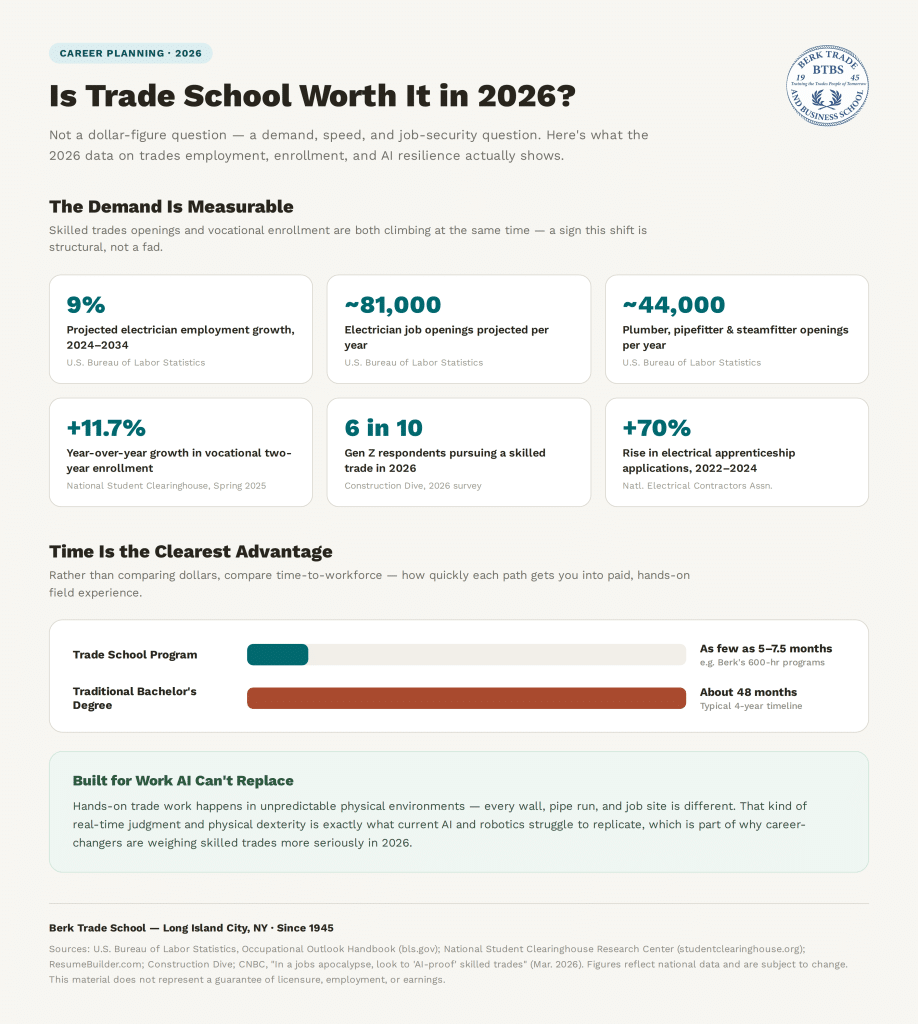
Skilled trades aren’t a fallback option in 2026 — they’re one of the more stable corners of the labor market, largely because there simply aren’t enough workers to fill the openings. The U.S. Bureau of Labor Statistics projects electrician employment to grow 9% from 2024 to 2034, well above the average for all occupations, with about 81,000 electrician openings projected per year over the decade — a mix of new positions and openings created as experienced electricians retire (BLS Occupational Outlook Handbook: Electricians). Plumbers, pipefitters, and steamfitters are projected to see 4% growth with about 44,000 openings per year over the same period (BLS Occupational Outlook Handbook: Plumbers, Pipefitters, and Steamfitters).
Much of that demand is generational: a large share of today’s licensed electricians and plumbers are approaching retirement, and the pipeline of new workers hasn’t kept pace with the number of people leaving the field — a structural gap that industry researchers expect to persist well into the next decade (Fortune).
Enrollment Data Backs Up the Shift
It’s not just anecdotal — the numbers back up what’s happening on the ground. According to the National Student Clearinghouse Research Center, enrollment at vocational-focused public two-year institutions grew 11.7% year-over-year in spring 2025, and is up nearly 20% since spring 2020, reversing a multi-decade decline in trade-focused enrollment (National Student Clearinghouse).
Younger workers are driving much of that trend. A 2025 survey of Gen Z adults found that roughly 4 in 10 were already working in, or actively pursuing, a blue-collar or skilled-trade career (ResumeBuilder.com), and a follow-up 2026 survey found that number climbing to roughly 6 in 10 (Construction Dive). Apprenticeship interest has moved just as fast: applications for commercial electrical apprenticeship programs jumped more than 70% nationally between 2022 and 2024, according to the National Electrical Contractors Association (CNBC).
Why Trade Careers Are Holding Up Well Against AI
A big part of the 2026 conversation around trade school is tied to artificial intelligence — specifically, which careers AI can and can’t touch. Hands-on trade work performed in unpredictable, physical environments — running conduit through an unfinished wall, diagnosing a leak behind a finished ceiling, adapting to a job site that never looks quite like the last one — requires real-time judgment and physical dexterity that current AI and robotics can’t replicate (CNBC). That’s a meaningfully different risk profile than many routine, screen-based office roles now facing automation pressure, and it’s a factor a growing number of career-changers are weighing heavily when they compare paths in 2026.
Dollar-for-dollar comparisons aside, one of the clearest, most measurable differences between trade school and a traditional four-year degree is time. A licensing-track trade program can be completed in a matter of months rather than years, meaning graduates step into entry-level field work — and start building the on-the-job experience that licensing boards require — far sooner than a traditional degree path allows. That head start matters in fields where employers are actively short-staffed and eager to bring in trained entry-level workers.
At Berk Trade School, for example, both the Electrical Installation Program and the Comprehensive Plumbing Program are 600-hour courses of study, with day and evening schedule options so working adults and career-changers can train around existing jobs or family responsibilities (Berk Trade School). That structure is designed around one goal: getting students trained, credentialed for entry-level work, and into the field as efficiently as possible.
What “Worth It” Actually Depends On
Trade school isn’t automatically the right call for everyone, and no responsible answer to “is it worth it” should suggest otherwise. It tends to make the most sense for people who:
- Prefer hands-on, physical, problem-solving work over classroom-only learning
- Want to enter a licensed field with a documented, well-defined pathway from entry-level to advanced credentials
- Are looking for a faster on-ramp into consistent, in-demand work
- Are comfortable with the physical demands of construction, electrical, or plumbing environments
It’s a less natural fit for people whose long-term goals require a bachelor’s degree by licensing rule (engineering, architecture, and similar regulated professions), or who are drawn to remote-first, desk-based careers. The right framework isn’t “trade school vs. college” in the abstract — it’s matching a specific training path to a specific, in-demand outcome.
Berk Trade School has trained tradespeople in New York City, Queens since 1945, offering ACCSC-accredited Electrical Installation and Comprehensive Plumbing Programs built around hands-on lab training. Berk’s Career Services team also supports students with additional credential tracking — including OSHA 30 and NYC Site Safety Training — that many employers look for when hiring entry-level electrical and plumbing workers (Berk Trade School Career Services).
This article is for general informational purposes and does not guarantee licensure, employment, or earnings. Licensing requirements, timelines, and program details are subject to change — always confirm current requirements with the New York Department of Buildings, NYS Department of State, and Berk Trade School’s admissions team.