
How to Become an Electrician in NYC: Your Career Pathway into a Booming Trade
If you’re looking for a hands-on career with real job security and a path that doesn’t require four years (or four years of tuition) at a college, the electrical trade is one of the smartest moves available right now. Between an aging city grid, a constant wave of new construction, and the electrification of everything from buildings to vehicles, New York City is going to need qualified electricians for a long time to come — and the training path from “no experience” to “licensed professional” is more clearly mapped than most people realize.
Here’s what the job market actually looks like, how the New York City electrician career pathway works step by step, and how Berk Trade School’s Electrical Installation Program is built to get you started on it.
The Electrical Job Market Is Booming — Here’s the Data
This isn’t just a sales pitch for the trades. The numbers back it up.
According to the U.S. Bureau of Labor Statistics, employment of electricians is projected to grow 9% from 2024 to 2034 — much faster than the average for all U.S. occupations (BLS Occupational Outlook Handbook). The BLS also projects roughly 77,400 openings for electricians every year, on average, over the next decade — many of them created as experienced tradespeople retire or move into other roles, opening space for newly trained workers to step in (BLS Occupational Outlook Handbook). Berk Trade School’s own Career Services team highlights this same demand to students, citing electrician job growth as “faster than the average of all occupations” with tens of thousands of openings projected each year.
And unlike many white-collar career paths, becoming an electrician doesn’t require a four-year degree to get started. The BLS notes that the typical entry-level education for the trade is a high school diploma or equivalent, with most electricians learning the rest through apprenticeship and/or work experience — meaning training happens largely on the job rather than through years of upfront classroom tuition alone (BLS Occupational Outlook Handbook).
In New York City specifically, the picture is even more favorable: an electrical grid and building stock that spans decades of different code eras, an ongoing wave of new residential and commercial construction, and rising demand tied to EV charging infrastructure, solar and battery installations, and building electrification upgrades all combine to keep demand for qualified electricians strong in the local market.
The NYC Electrician Career Pathway, Step by Step
Because New York State does not issue a single statewide electrician license, electrical credentials in New York City are governed entirely by the NYC Department of Buildings (DOB). Unlike some trades, NYC does not run a separate multi-tier license from “journeyman” up to “master” — instead, after building up qualifying training and supervised experience, a candidate tests directly for a Master or Special Electrician license. Here’s how the path generally works:
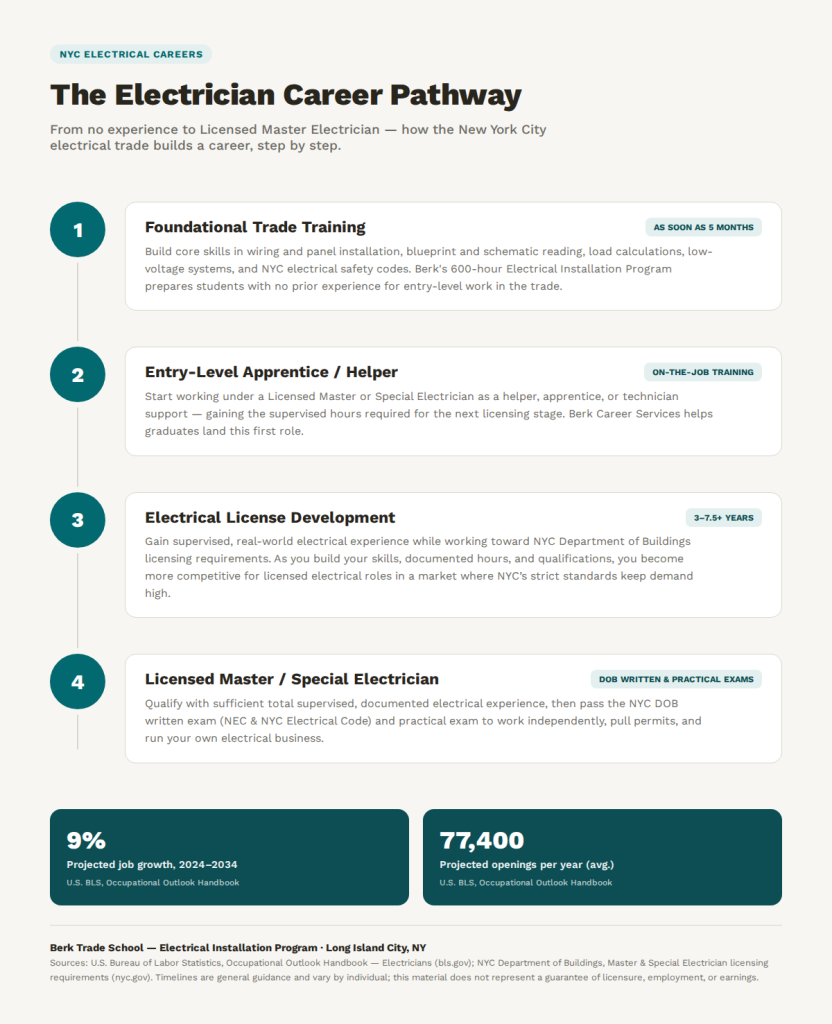
Step 1 — Foundational Trade Training.
Before stepping onto a jobsite, most successful electricians start with structured trade-school training that builds core technical knowledge: wiring and panel installation, blueprint and schematic reading, load calculations, low-voltage systems, and NYC electrical safety codes. This is where a program like Berk’s 600-hour Electrical Installation Program comes in — it’s designed to take someone with no prior experience and get them ready for entry-level work in the field while building toward New York licensing requirements.
Step 2 — Entry-Level Apprentice / Helper Role.
Graduates of trade training typically enter the workforce in supervised, entry-level roles — electrician helper, apprentice, or technician support — working under a licensed Master or Special Electrician while they accumulate the hands-on hours the DOB requires for licensing.
Step 3 — Electrical License Development.
From here, aspiring electricians gain supervised, real-world electrical experience while working toward NYC DOB licensing requirements — generally in the range of 3.5 to 7.5+ years, depending on the individual’s training background, education credit, and documented hours (NYC Department of Buildings). As you build your skills and qualifications during this stage, you become more competitive for licensed electrical roles in a market where NYC’s strict standards keep demand high.
Step 4 — Licensed Master or Special Electrician.
The top of the pathway is a Master Electrician or Special Electrician License, issued by the NYC DOB. To qualify, a candidate must meet the required supervised experience and then pass both a written exam (covering the National Electrical Code and NYC Electrical Code) and a hands-on practical exam before submitting a license application (NYC Department of Buildings). A Licensed Master Electrician can work independently, pull permits, supervise other electricians, and run their own electrical contracting business — the ceiling of the trade.
Each stage builds on the one before it, but the starting point — the training that opens the door to that first apprentice or helper role — is the one every aspiring electrician has full control over today.
(See the infographic below for a visual breakdown of this full pathway.)
Why Berk Trade School Is Built for Step One
Berk Trade School has been training New York City electricians and plumbers since 1945 — making it one of the longest-running trade schools in the city. The Electrical Installation Program is a 600-hour course of study, available on day or evening schedules, that students can complete in as little as 5 months (day) or roughly 7.5 months (evening) — a fraction of the time of a traditional degree path.
A few things set the Berk experience apart for students starting Step 1 of the pathway:
- Instructors who’ve actually worked the trade. Berk’s instructors are working tradespeople with real field experience — not just classroom educators — which means students learn current NYC codes, real job-site practices, and the kind of practical shortcuts that only come from years on the job.
- A 90% graduation rate. Small class sizes, individualized academic advising, and a formal makeup-hours policy mean that life’s inevitable disruptions — work schedules, family responsibilities — don’t have to derail a student’s path to finishing the program.
- Free one-on-one tutoring. Any student who needs extra support gets targeted, instructor-led tutoring at no additional cost, focused on the exact gap that’s holding them back — not generic review.
- Hands-on learning from day one. The curriculum simulates real job-site conditions in the classroom, integrating theory with practical lab work — wiring, panel installation, and load calculations — so students build the muscle memory and confidence employers look for.
- Financial aid for those who qualify. Berk is approved to accept federal financial aid through FAFSA (including Pell Grants and federal student loans), veteran benefits, and ACCES-VR funding, which can significantly reduce out-of-pocket costs for eligible students.
The Support Doesn’t Stop at Graduation
Finishing the program is only half the equation — actually landing that first job is what turns training into a career. That’s where Berk’s Career Services come in. Available to all graduates at no extra cost, Career Services include:
- Resume assistance to highlight trade training, tools proficiency, and job readiness.
- Career planning that helps map short-term goals, 12-month objectives, and realistic job targets.
- Employer connections — Berk maintains active relationships with electrical and plumbing employers across the NYC area who are specifically looking for Berk graduates, and facilitates introductions.
- Job search support and interview preparation, so graduates are ready to speak confidently about their training and hands-on readiness for entry-level technician, aide, helper, maintenance, or support roles.
- Credential tracking, including guidance on additional certifications relevant to a student’s target role, such as OSHA 30 and NYC Site Safety Training (SST).
- Longer-term career planning, covering continuing education, future certifications, and networking as graduates progress from entry-level roles toward licensed electrical status.
Berk reports an approximate 70% job placement rate among graduates who sought employment in their trade — a reflection of how closely the training and career-support pipeline is tied together (Why Students Choose Berk). Recent graduates echo the same experience: one Electrical Program graduate shared that within months of finishing the program, she was already working as an apprentice electrician.
The electrical trade has real momentum behind it — a high volume of projected job openings and a clear, well-documented licensing path that rewards hands-on skill over classroom hours alone. Berk Trade School exists to get you through Step 1 of that pathway as efficiently and thoroughly as possible, and to keep supporting you as you move toward your first job in the field.
If you’re ready to explore whether the Electrical Installation Program is right for you, reach out to Berk’s admissions team to learn more about class schedules, financial aid eligibility, and what your first steps in the trade could look like.
Sources: U.S. Bureau of Labor Statistics, Occupational Outlook Handbook — Electricians; NYC Department of Buildings, Obtain a Master & Special Electrician License; Berk Trade School, Why Students Choose Berk, Career Services, and berktradeschool.com homepage. This article is for general informational purposes only and does not guarantee licensure, employment, or earnings.