
If you’ve started researching entry-level electrician or plumbing jobs in New York City, you’ve probably run into the phrase “OSHA 30” on job postings, employer requirements, or even Berk Trade School’s own Career Services materials. It sounds official — and it is — but what does it actually mean, and does every new tradesperson need one? Here’s a straightforward breakdown.
What OSHA 30 Actually Is
OSHA 30 refers to the 30-Hour Construction Outreach Training course, part of the U.S. Occupational Safety and Health Administration’s (OSHA) national Outreach Training Program (OSHA.gov). The program exists to give construction workers a solid foundation in recognizing, avoiding, and preventing common jobsite hazards.
A few important facts about what OSHA 30 is — and isn’t:
- It’s training, not a license. OSHA itself states that none of the courses within the Outreach Training Program are considered a formal “certification” in the legal sense — they’re an orientation to occupational safety, and workers may still need additional training on job-specific hazards required by OSHA standards (OSHA.gov).
- It’s voluntary at the federal level. Completing OSHA 30 is not a nationwide OSHA requirement. However, individual states, cities, unions, or employers can — and often do — require it as a condition of working on a job site (OSHA.gov).
- It’s more advanced than OSHA 10. The 10-hour course is designed to build basic hazard awareness for entry-level workers, while the 30-hour course goes deeper and is generally recommended for workers taking on more responsibility, or anyone likely to spend significant time on active construction sites (OSHA.gov).
- It covers a broad range of topics, including OSHA’s “Focus Four” hazards (falls, electrocution, struck-by, and caught-in/between hazards), personal protective equipment, scaffolds, excavations, fire prevention, confined spaces, and materials handling, among others (OSHA.com Outreach Training).
- Completion earns a wallet card, not a diploma — issued by an OSHA-authorized trainer once the course and a required survey are completed (OSHA.gov).
Do You Actually Need It? It Depends on Where You’re Working
This is the part that trips people up: OSHA 30 isn’t universally mandatory, but in New York City it’s tightly connected to a separate, and very real, local requirement — Site Safety Training (SST).
Under Local Law 196 of 2017, most construction and demolition workers at NYC job sites that require a designated Construction Superintendent, Site Safety Coordinator, or Site Safety Manager must complete 40 hours of DOB-approved safety training and carry a Site Safety Training (SST) Worker Card before they can work on those sites (NYC Department of Buildings). Smaller job sites — such as minor alterations or new construction of 1-, 2-, or 3-family homes — are generally exempt (NYC Department of Buildings).
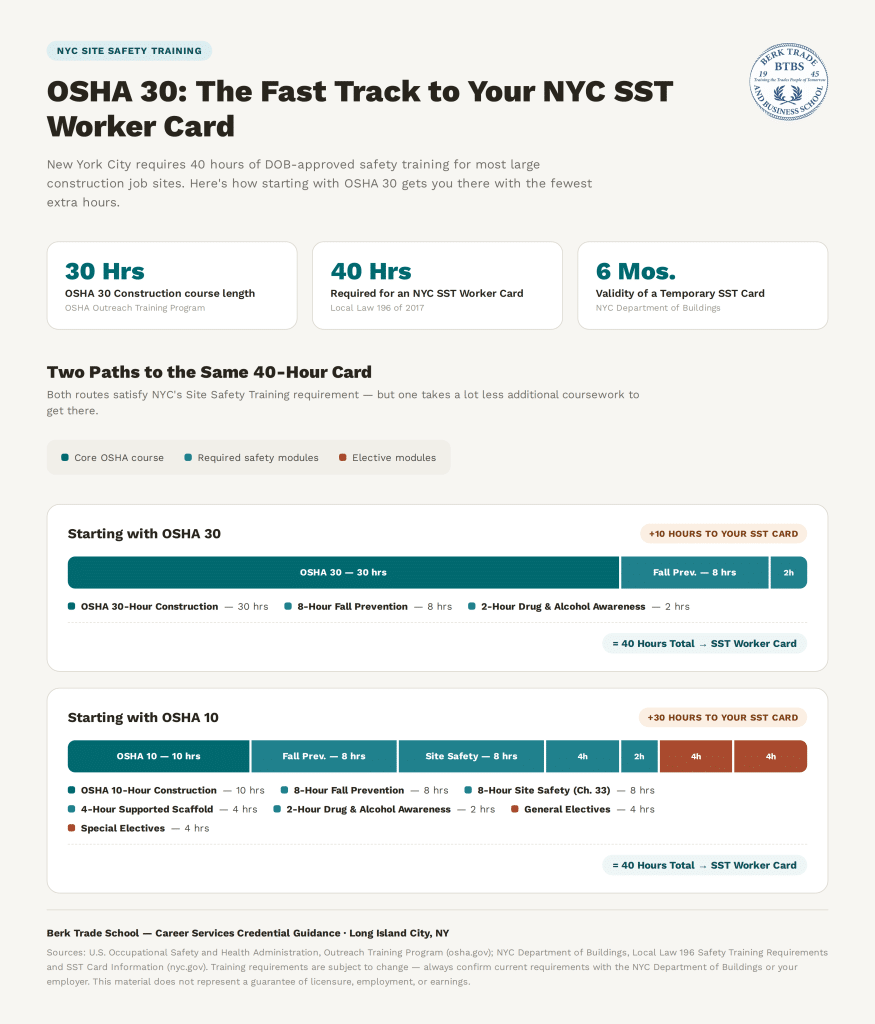
Here’s where OSHA 30 becomes the smart move: to reach that 40-hour SST requirement, workers can take either path below.
- With OSHA 30: 30-Hour OSHA + 8-Hour Fall Prevention + 2-Hour Drug and Alcohol Awareness = 40 hours total (NYC Department of Buildings).
- With OSHA 10: 10-Hour OSHA + 8-Hour Fall Prevention + 8-Hour Site Safety + 4-Hour Supported Scaffold + 2-Hour Drug and Alcohol Awareness + 4 hours of general electives + 4 hours of special electives = 40 hours total (NYC Department of Buildings).
In other words, starting with OSHA 30 gets you to a full NYC SST Worker Card with only 10 additional hours of coursework, versus 30 additional hours if you start with OSHA 10. Workers who complete OSHA 10 or OSHA 30 within the required window can also apply for a Temporary SST Card, valid for six months, while they finish the remaining hours (NYC Department of Buildings). It’s also worth noting that an OSHA card and an SST card are not the same thing — the SST Worker Card is issued specifically by a DOB-registered training provider and must be renewed roughly every five years, while OSHA cards do not expire on their own (NYC Department of Buildings).
Supervisory roles — Site Safety Managers, Site Safety Coordinators, and Construction Superintendents — face a higher bar: 62 hours of training, which also builds on an OSHA 30 foundation (NYC Department of Buildings).
Why This Matters for New Electricians and Plumbers
If your first job after trade school is on a large NYC commercial job site — a new apartment building, a hospital renovation, a big commercial buildout — there’s a good chance the site falls under Local Law 196’s SST requirements, meaning you’ll need that 40-hour card before you can even step on site. Getting ahead of it with OSHA 30 means less additional coursework later and one fewer hurdle standing between you and your first day of work.
That’s exactly why Berk Trade School’s Career Services builds credential planning into every graduate’s job-search support. As part of each student’s development plan, Career Services tracks relevant credentials — including OSHA 30 and NYC SST — based on the specific type of role a graduate is targeting, alongside resume development, interview preparation, and employer connections (Berk Trade School Career Services). For graduates aiming at larger commercial job sites, having this credential in hand — or knowing exactly how to get it — can be the difference between a smooth start and a stalled one.
The Bottom Line
OSHA 30 isn’t a license, and it isn’t required for every job in the trades. But if you’re planning to work on larger NYC construction sites as an electrician or plumber, it’s one of the most efficient credentials you can pursue — it satisfies the bulk of the city’s 40-hour Site Safety Training requirement in a single course, and it signals to employers that you take jobsite safety seriously from day one.
If you’re not sure whether your target role or job sites will require it, that’s exactly the kind of question Berk’s Career Services team can help you sort out as part of your post-graduation planning.
Sources: U.S. Occupational Safety and Health Administration, Outreach Training Program; NYC Department of Buildings, Local Law 196 Safety Training Requirements and SST Card Information; Berk Trade School, Career Services. This article is for general informational purposes only and does not guarantee licensure, employment, or earnings. Training requirements and site safety rules are subject to change — always confirm current requirements with the NYC Department of Buildings or your employer.